
Why Ultrasonic Extraction?
How sound waves make a better mushroom extract
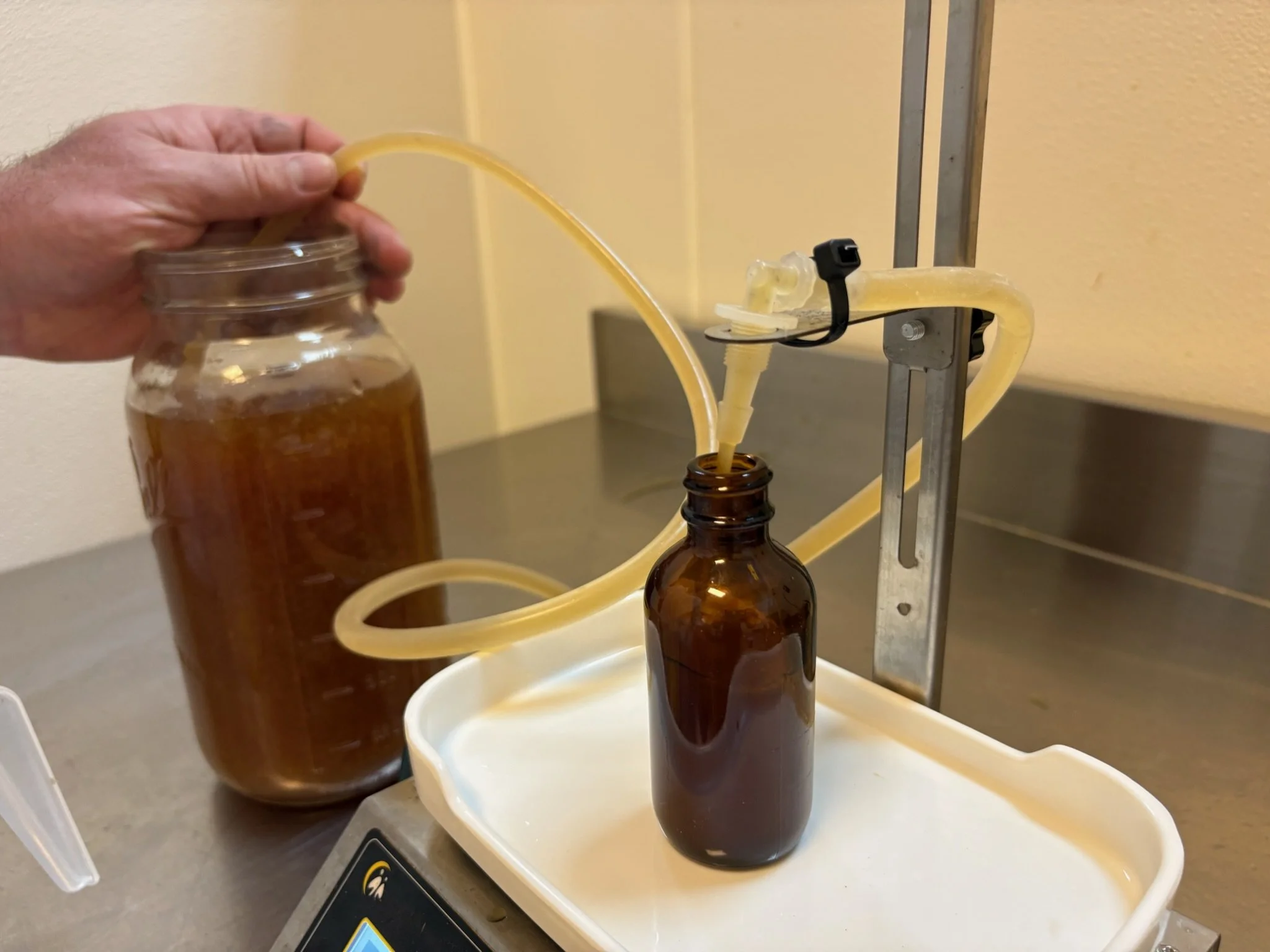
When people hold one of our tinctures up to the light next to a store-bought bottle, the first question is usually: why is yours so much darker? Part of the answer is the mushrooms. We use only whole fruiting mushrooms grown on our farm, never mycelium on grain. The other part is how we get the medicine out of them. After more than fifteen years of making extracts, the biggest improvement we’ve made to our process is by leveraging ultrasonic extraction.
What’s the challenge with extracting mushrooms?
Mushrooms hold their medicine behind a tough wall of cells. Unlike plant cells, which are built from cellulose, fungal cell walls are made largely of chitin, which doesn’t break down in our digestive tract and it doesn’t dissolve easily in alcohol or water.
The traditional workarounds to access these compounds are heat and time: long soaks in alcohol (weeks to months) and long simmers in hot water (hours). These work, but slowly and incompletely. Prolonged high heat can also degrade some of the more delicate compounds you were trying to save in the first place.
What does ultrasonic actually do?
“Ultrasonic” is a fancy way of saying sound waves pitched above the range of human hearing. When we pulse those waves through mushrooms soaking in liquid, they create millions of microscopic bubbles that form and collapse over and over in fractions of a second. This is called cavitation.
Each collapsing bubble releases a tiny burst of force: shockwaves, micro-jets of liquid, and intense shear right at the surface of the mushroom tissue. That force cracks open the chitin walls and pushes solvent into the cells, then carries the compounds back out. Instead of waiting for heat and time to slowly wear through the walls, we break through them directly.
Why does that matter for what’s in the bottle?
More of the medicine comes out. Research comparing methods has found ultrasonic extraction pulls more triterpenes and phenolic compounds from reishi than conventional heat-based extraction, and in less time.
Both sides of the medicine, in balance. Mushrooms carry water-soluble compounds (beta-glucans and other polysaccharides) and alcohol-soluble compounds (triterpenes, sterols, phenolics). Ultrasonic works in both alcohol and water, so we use it in both phases of our dual extraction.
Less heat, less damage. Because the sound waves are doing the work, we don’t need to rely as much on prolonged high heat, which helps protect heat-sensitive compounds.
Consistency. A controlled, repeatable process means each batch comes out much like the last, so the bottle you reorder matches the one you liked.
How do we use it on the farm?
We start by shredding and freezing our farm-grown mushrooms; freezing begins breaking down cell structure, and shredding increases surface area. After thawing, we do our alcohol extraction using organic alcohol and several rounds of ultrasonic treatment. We press all the liquid out, then simmer the mushrooms in hot water and run them through ultrasonic treatments again to pull out the water-soluble compounds. We add extra mushrooms at each stage so every bottle is as concentrated as we can make it.
More isn’t always better with ultrasound. Too much intensity for too long can start breaking down the very polysaccharides you’re after. That’s why we work in pulsed rounds and keep a close eye on temperature rather than running the machine full blast.
Is this just a gimmick?
Ultrasonic extraction is well studied in food science and natural products research, and it’s widely used to extract compounds from plants and medicinal fungi. It’s newer to small-scale production because the equipment is an investment, but we think it’s one of the clearest ways a small farm can make an extract that stands up to anything on the shelf.
Citations and further reading:
Oludemi, T., et al. (2018).
Title: Extraction of triterpenoids and phenolic compounds from Ganoderma lucidum: optimization study using the response surface methodology
Journal: Food & Function, 9(1), 209–226
Relevance: Compared heat-assisted and ultrasound-assisted extraction of reishi; ultrasonic was the most effective for triterpenes and phenolics.
🔗 https://doi.org/10.1039/c7fo01601h
Zheng, S., Zhang, W., & Liu, S. (2020).
Title: Optimization of ultrasonic-assisted extraction of polysaccharides and triterpenoids from the medicinal mushroom Ganoderma lucidum
Journal: PLoS ONE, 15(12), e0244749
Relevance: Pulled polysaccharides and triterpenoids together in one ultrasonic process; the polysaccharides showed higher antioxidant capacity than those from traditional hot water extraction.
🔗 https://doi.org/10.1371/journal.pone.0244749
Sun, Y., Zhang, M., & Fang, Z. (2020).
Title: Efficient physical extraction of active constituents from edible fungi and their potential bioactivities: A review
Journal: Trends in Food Science & Technology
Relevance: Overview of ultrasound and other physical extraction technologies applied to medicinal and edible mushrooms.
🔗 https://doi.org/10.1016/j.tifs.2019.02.026
Du, B., Jeepipalli, S. P. K., & Xu, B. (2022).
Title: Critical review on alterations in physiochemical properties and molecular structure of natural polysaccharides upon ultrasonication
Relevance: Explains how excessive ultrasonication can break down polysaccharides, which is why controlled, pulsed treatment matters.
🔗 https://pmc.ncbi.nlm.nih.gov/articles/PMC9526224
Statements on this site have not been evaluated by the Food and Drug Administration. Our products are not intended to diagnose, treat, cure, or prevent any disease. By FDA regulations extracts are considered a nutritional supplement.