What is a mushroom powder?
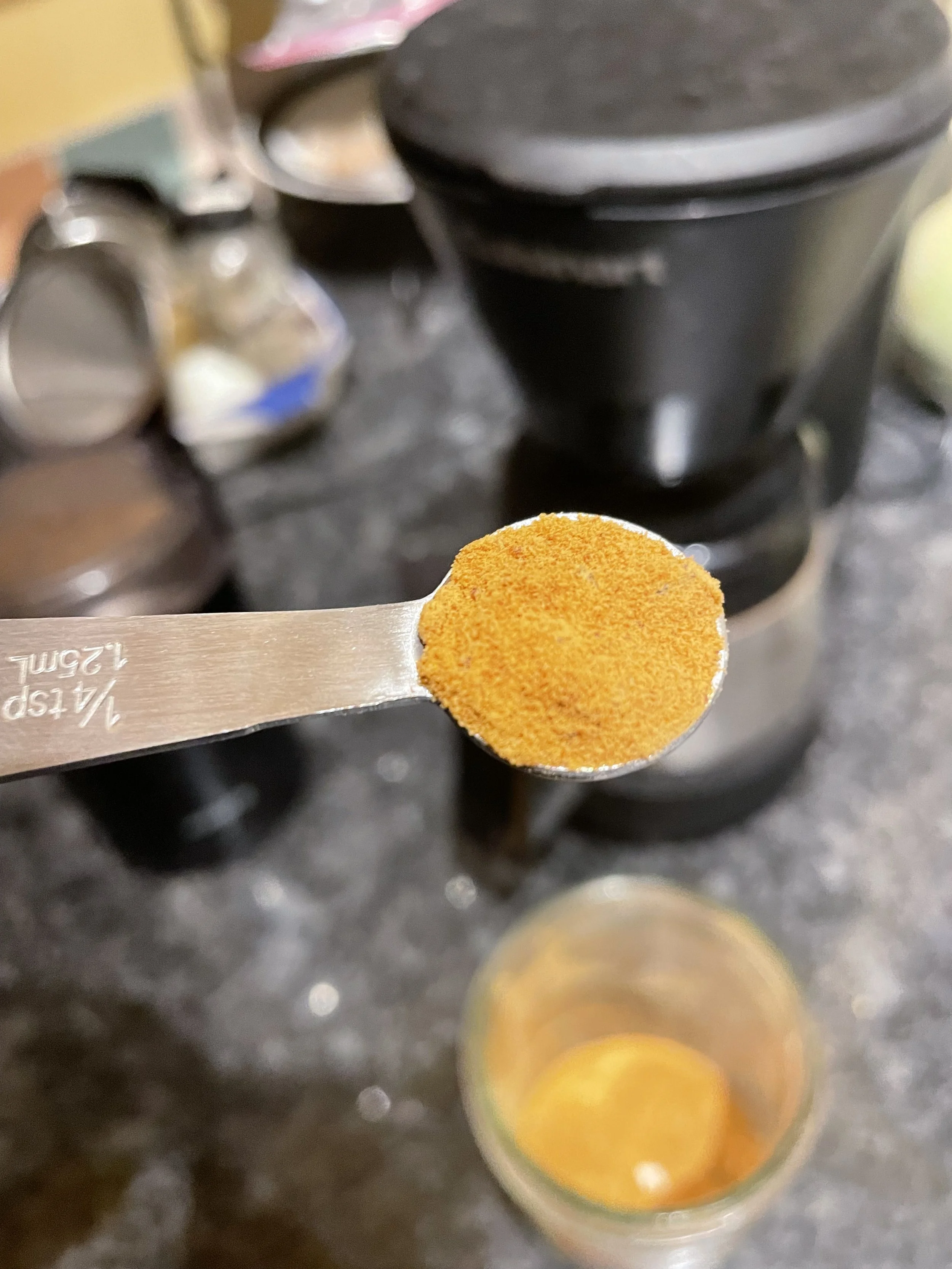
Our mushroom powders are made from the mushrooms we grow on our farm, dried and milled. Nothing else goes in: no fillers, no grain, no flavorings. We make two: our Daily Four blend (shiitake, oyster, lion’s mane, and reishi) and a pure lion’s mane powder.
Powders and tinctures are two sides of the same process. When we prepare our mushrooms, they separate into a juice and a pulp. The juice goes into our tinctures. The pulp, which holds most of the mushroom’s fiber and cell wall material, becomes our powder. So each product carries a different part of the mushroom, and nothing goes to waste.
How do you make them?
We start the same way as our tinctures: we shred our farm-grown mushrooms and freeze them. Freezing breaks down the cell structure, and when the mushrooms thaw they release their juice. We press that juice out for our tinctures. The remaining pulp is dried until it’s crisp, then milled to a medium grind. We keep some texture on purpose. The fiber is part of what makes this a whole-mushroom food.
For the Daily Four, we blend the four species in set proportions. Shiitake and oyster make up most of the blend, with lion’s mane and a smaller amount of reishi.
What are the benefits?
The cell walls of mushrooms are built largely from beta-glucans and chitin, and these are what a powder carries most of. Beta-glucans are among the most studied compounds in medicinal mushrooms (see citations below). Mushrooms also contain ergosterol, a sterol and the precursor to vitamin D2.
How a powder compares with a tincture: a tincture concentrates the compounds that dissolve in alcohol and water. A powder gives you the whole structural part of the mushroom in a form you can eat. Many people use both.
How should they be used?
Stir about a teaspoon into coffee, tea, soup, broth, oatmeal, or a smoothie. Beta-glucans are bound up in the cell walls, and heat helps release them, so a hot drink or cooking is the best way to take a powder. Like tinctures, they work best taken consistently, a little every day.
Why doesn’t it dissolve?
Because it’s whole mushroom. Most of a mushroom is fiber, including chitin and the beta-glucans that make up its cell walls, and fiber doesn’t dissolve. You’ll see some texture settle at the bottom of your cup. Stir it in, or blend it into a smoothie or soup.
If a mushroom powder dissolves completely, it’s usually an extract, often dried onto a carrier like maltodextrin. Extracts have their place (that’s what our tinctures are), but they aren’t the same as eating the mushroom itself.
How do they taste?
Like mushrooms! Lion’s mane is mild and slightly sweet. The Daily Four is earthier and savory, with a slight bitterness from the reishi. It goes well in broths, soups, and coffee.
Are powders safe?
Generally, yes. These are dried mushrooms, the same ones we sell fresh. However, anyone with mushroom allergies, immune disorders, or who takes medications should check with a healthcare provider first.
How should I store powders?
Keep the jar tightly closed in a cool, dry place. Moisture is the main enemy, so keep it away from the stove and kettle and use a dry spoon. Stored well, the powder keeps for one to two years.
How do our powders compare with other mushroom products?
Mushroom products are everywhere now: powders, capsules, gummies, and mushroom coffee. They’re convenient, but it’s worth looking at what’s actually inside, and how much you’re paying for it.
Commercial powders. Many are made from mycelium, the network of thread-like fibers a fungus grows before it produces mushrooms. In most commercial production, mycelium is grown on sterilized grain such as rice or oats, and the two can’t be fully separated. Much of the product can end up being grain starch rather than fungal material. Labels often list a high “polysaccharide” content, but starch is a polysaccharide too. The number to look for is beta-glucans. If a label lists polysaccharides but doesn’t list beta-glucans, ask why.
Capsules. A typical capsule holds about half a gram of powder. Getting a meaningful daily amount can mean taking several capsules a day, and you pay for the capsule, the filler, and the convenience. Per gram of actual mushroom, capsules are often the most expensive way to buy it.
Mushroom coffee and drink mixes. These are mostly coffee or cocoa, with a small amount of mushroom added. Many list their mushrooms in a “proprietary blend” with no amounts given, so you can’t tell how much you’re getting. If it’s a small amount, you’re paying mushroom prices for coffee.
How to compare. Look for three things: what part of the mushroom it’s made from (fruiting body or mycelium), where it was grown, and how many grams of mushroom you get per serving. Then work out the price per gram of mushroom, not per jar or per serving.
Our powders are made only from mushroom fruiting bodies, the mushrooms themselves, grown on our farm. There’s no grain, filler, or capsule, so you’re paying for the mushroom. It’s a little less convenient, and it’s the most direct way we know to eat them.
What’s next?
We’re always looking for ways to make our powders better, and two projects are in the works.
Freeze drying. Drying with heat can break down some of the more delicate compounds in mushrooms. Freeze drying removes the water at very low temperatures instead, which keeps more of the mushroom intact: its color, its aroma, and more of the compounds that heat can damage.
Vitamin D. Mushrooms are one of the few non-animal foods that can make vitamin D. Like us, they make it in sunlight: UV light converts the ergosterol in their cell walls into vitamin D2. We’re experimenting with exposing our mushrooms to UV light before drying to raise their vitamin D content.
Both projects take time. Before we can say anything on a label about vitamin D or any other change, we have to meet food and supplement regulations, which means lab testing to back up what we claim. We’d rather take it slowly and get it right. We’ll share updates as these projects move forward.
Citations and further reading
Wasser, S. P. (2002). Medicinal mushrooms as a source of antitumor and immunomodulating polysaccharides. Applied Microbiology and Biotechnology, 60(3), 258–274. https://doi.org/10.1007/s00253-002-1076-7
Cheung, L. M., et al. (2003). Antioxidant activity and total phenolics of edible mushroom extracts. Food Chemistry, 81(2), 249–255. https://doi.org/10.1016/S0308-8146(02)00419-3
Mattila, P., et al. (2002). Sterol and vitamin D2 contents in some wild and cultivated mushrooms. Food Chemistry, 76(3), 293–298. https://doi.org/10.1016/S0308-8146(01)00285-X
Jayakumar, T., et al. (2011). Experimental and clinical pharmacology of Lentinula edodes (Shiitake mushroom): a review. Journal of Traditional and Complementary Medicine, 1(1), 49–55. https://doi.org/10.1016/S2225-4110(16)30069-0