About our Reishi + Elderberry Tincture
In short; Reishi is the old-world “mushroom of immortality,” while Elderberry has been the go-to backyard remedy in many cultures for generations. On their own, each has a long history of use and a growing body of research behind it. Together, they cover each other’s gaps, and that’s why we put them in one bottle.
Elderberry: the quick responder
North American elderberry (Sambucus canadensis) grows throughout our agroforestry systems, and we harvest the berries at full ripeness. The deep purple color comes from anthocyanins, a family of polyphenols that do much of elderberry’s work.
What the research suggests:
Shorter, milder colds and flu. In a controlled trial during a Norwegian flu season, people who took elderberry extract within two days of symptoms starting recovered several days sooner than those on placebo. A 2019 meta-analysis pooling four controlled trials found a large overall effect on how long upper respiratory symptoms lasted. A separate trial in long-haul air travelers found shorter, milder colds in the elderberry group, though it didn’t prevent colds from starting.
Working against the virus at more than one stage. Lab research shows elderberry can interfere with the flu virus both as it enters cells and after infection has taken hold. It also prompts cells to release immune signaling molecules that help coordinate a response.
Antioxidant support. Elderberry’s anthocyanins and other polyphenols are strong antioxidants that help counter oxidative stress.
Elderberry tends to work best when taken early and often during cold and flu season.
Reishi: the slow builder
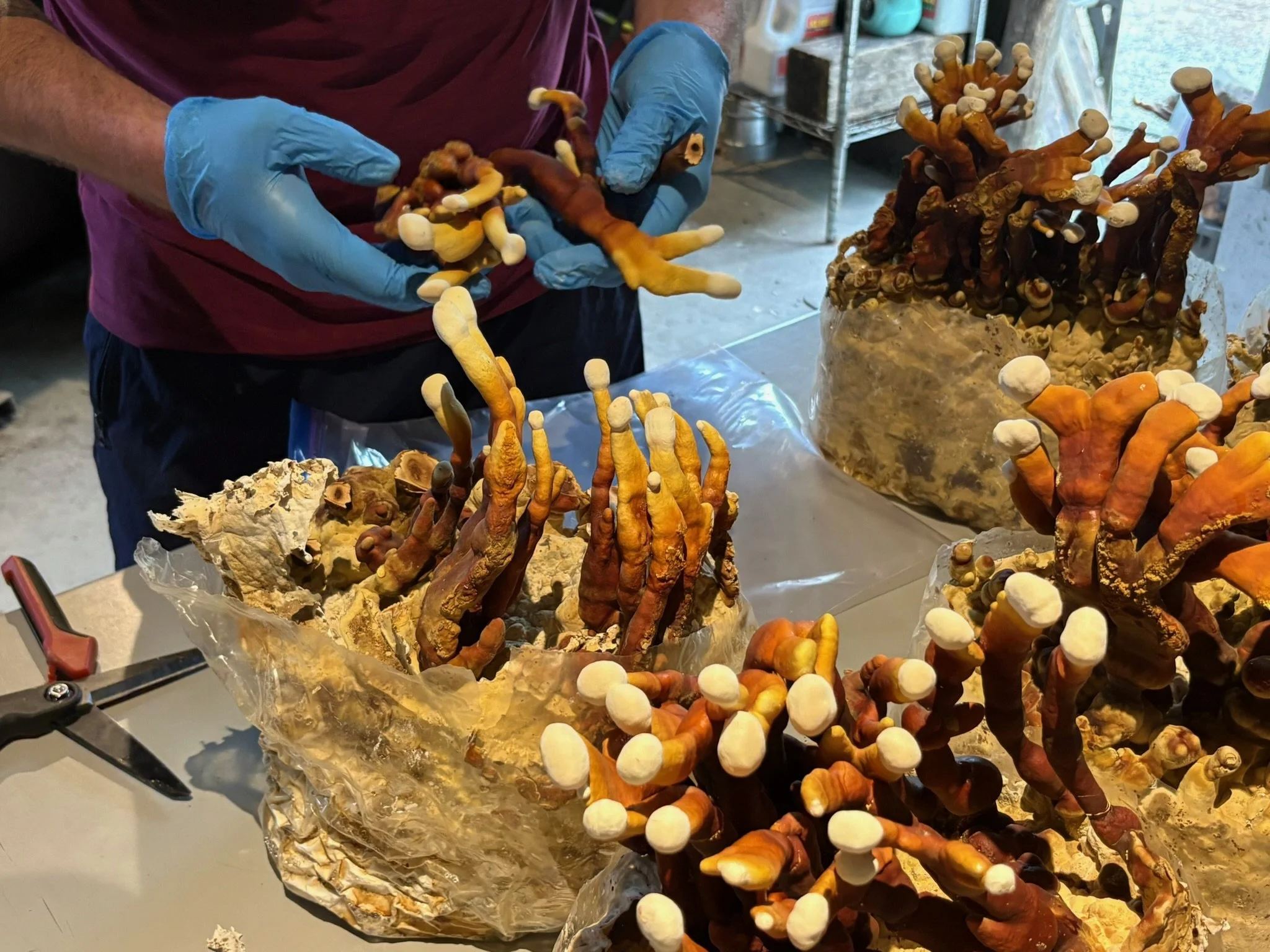
The reishi we grow is Ganoderma lingzhi, the East Asian species behind two thousand years of use as lingzhi. We grow it for its higher triterpene content.
You can view this brand new tincture here or check out the full farm store here.
What the research suggests:
Immune modulation. Reishi’s beta-glucans and other polysaccharides interact with immune cells such as macrophages, lymphocytes, and natural killer cells. The result is better described as helping the immune system regulate itself than simply “boosting” it.
Triterpenes. These bitter, alcohol-soluble compounds (ganoderic acids and their relatives) are studied for anti-inflammatory and antioxidant activity, and they’re a big part of why reishi is considered an adaptogen.
A tonic, not a quick fix. Traditionally, reishi is taken daily over long periods, and its benefits are understood to build over time.
Why they make such good partners
Different timescales. Elderberry acts in the moment: early in a cold, during flu season, when you’ve been exposed. Reishi works slowly in the background, supporting a well-regulated immune system. One bottle covers both.
Different compounds, little overlap. Elderberry brings anthocyanins and polyphenols. Reishi brings beta-glucans and triterpenes. They aren’t doing the same job twice; they reach the immune system from different directions.
Each balances the other’s flavor. Reishi on its own is famously bitter. Elderberry adds fruit and a little sweetness, which makes a daily dose much easier to keep up with, and consistency is what matters most with reishi.
Both come from our land. The reishi is grown on our farm, and the elderberries come from our own agroforestry plantings. That’s a medicine chest you can trace to a single hillside in the Finger Lakes.
How we make it
We extract ultrasonically. Pulsed sound waves break open reishi’s tough chitin cell walls and the elderberries’ skins so we can pull out both the water-soluble compounds (beta-glucans, polysaccharides) and the alcohol-soluble compounds (triterpenes, polyphenols) in a controlled process with less heat. We add extra reishi and berries to each batch for the highest dosage per bottle.
Hold ours up to the light next to what’s on the shelf. Deep red-black, bitter-fruity, with visible solids: that’s what a real extract looks like. We never use mycelium on grain.
How should I take it?
Take 1–2 droppers daily under the tongue or in water, tea, or juice, ideally at the same time each day. Through the cold months, many people take an extra dose at the first sign of a sniffle. Keep taking it the rest of the year; reishi’s benefits build with steady use.
Is it safe?
For most people, yes. Check with your healthcare provider first if you are pregnant or nursing, have an autoimmune condition, take immunosuppressant medications, or have liver concerns. Raw, unripe elderberries and the plant’s stems and leaves should not be eaten; our tincture uses only ripe, processed berries.
Citations and further reading:
Zakay-Rones, Z., Thom, E., Wollan, T., & Wadstein, J. (2004).
Title: Randomized study of the efficacy and safety of oral elderberry extract in the treatment of influenza A and B virus infections
Journal: Journal of International Medical Research, 32(2), 132–140
Relevance: Controlled trial in 60 adults with flu; elderberry shortened recovery time.
🔗 https://doi.org/10.1177/147323000403200205
Hawkins, J., Baker, C., Cherry, L., & Dunne, E. (2019).
Title: Black elderberry (Sambucus nigra) supplementation effectively treats upper respiratory symptoms: A meta-analysis of randomized, controlled clinical trials
Journal: Complementary Therapies in Medicine, 42, 361–365
Relevance: Pooled four controlled trials; elderberry substantially reduced the duration of cold and flu symptoms.
🔗 https://doi.org/10.1016/j.ctim.2018.12.004
Tiralongo, E., Wee, S. S., & Lea, R. A. (2016).
Title: Elderberry supplementation reduces cold duration and symptoms in air-travellers: A randomized, double-blind placebo-controlled clinical trial
Journal: Nutrients, 8(4), 182
Relevance: In 312 long-haul passengers, elderberry shortened colds and reduced symptom severity.
🔗 https://doi.org/10.3390/nu8040182
Torabian, G., Valtchev, P., Adil, Q., & Dehghani, F. (2019).
Title: Anti-influenza activity of elderberry (Sambucus nigra)
Journal: Journal of Functional Foods, 54, 353–360
Relevance: Showed elderberry acts on flu at multiple stages and stimulates immune signaling molecules.
🔗 https://doi.org/10.1016/j.jff.2019.01.031
Wachtel-Galor, S., Yuen, J., Buswell, J. A., & Benzie, I. F. F. (2011).
Title: Ganoderma lucidum (Lingzhi or Reishi): A Medicinal Mushroom
Source: Herbal Medicine: Biomolecular and Clinical Aspects, 2nd ed., CRC Press
Relevance: Thorough, freely available overview of reishi’s history, compounds, and research.
🔗 https://www.ncbi.nlm.nih.gov/books/NBK92757/
Gao, Y., Chan, E., & Zhou, S. (2004).
Title: Immunomodulating activities of Ganoderma, a mushroom with medicinal properties
Journal: Food Reviews International, 20(2), 123–161
Relevance: Reviews how reishi polysaccharides, proteins, and triterpenes affect immune cells.
🔗 https://doi.org/10.1081/FRI-120037158
Ren, L., Zhang, J., & Zhang, T. (2021).
Title: Immunomodulatory activities of polysaccharides from Ganoderma on immune effector cells
Journal: Food Chemistry
Relevance: Recent review of how reishi polysaccharides interact with innate and adaptive immunity.
🔗 https://doi.org/10.1016/j.foodchem.2020.127933
These statements have not been evaluated by the Food and Drug Administration. This product is not intended to diagnose, treat, cure, or prevent any disease. By FDA regulations it is considered a nutritional supplement.
